Mads Buciek All work

steadyHealth-first training companion, iOS concept

Training that fits your week.

A weekly plan for strength, cycling and running that bends around energy, calendar and family, and counts consistency instead of streaks. For adults who train for health, whose weeks rarely go to plan.

  • Research
  • Product strategy
  • iOS prototype
  • 2026

From research to prototype, fast

One product question, taken from research to product requirements to a clickable iOS prototype: can a training app that adapts to energy, schedule and family life keep people training for health?

Role
Product design: research, requirements, prototype
Scope
Research, product requirements and planning rules, iOS prototype
Year
2026

Fitness apps lose almost everyone within weeks

And the mechanics meant to keep people fit poorly with those who train for health. Streaks, leaderboards and performance targets serve people chasing results. When a sick child or a late meeting breaks the plan, the app records a failure.

3–8%of health and fitness installs are still active on day 30, depending on the source.
35%of all annual cancellations happen in month one, and 95% of annual cancellers never return.
25%is the median first annual renewal in Health & Fitness. The upper quartile is 37%.
Sources: Business of Apps (citing AppsFlyer and Adjust); 9to5Mac on RevenueCat 2026; RevenueCat; RevenueCat renewal rates. Figures as of 23 November 2026; methods differ, so read them as ranges.

Adults who train for health need a plan that bends when life does, and feedback that treats a missed session as information, not a lapse. Existing apps ask them to bend to the plan.

Working problem statement

What the evidence says, and what it means for the product

The research agrees on one point: motivation that comes from the person (autonomy, competence, a plan that fits their life) predicts long-term exercise better than external pressure.

  1. Broken streaks sap motivation

    Streaks raise motivation while they last; a broken one reduces it, and highlighting the break can backfire.

    → No daily streak. Measure weeks, and let a missed week be absorbed, not announced.

    Silverman & Barasch 2023, INSEAD
  2. Competition adds stress

    In a preregistered experiment, competition-based gamification raised stress and negative social dynamics; a self-exploration version reduced them.

    → No leaderboards in v1. Private reflection instead.

    Bai, Kybernetes
  3. Autonomy predicts adherence

    Across 66 studies, autonomous motivation and competence predicted exercise; intrinsic motivation best predicted long-term adherence.

    → Users shape and edit their own plan, and see capacity grow.

    Teixeira et al. 2012
  4. One miss does not break a habit

    New habits took a median of 66 days to become automatic, and missing one opportunity did not materially affect it.

    → The first 12 weeks are the habit window. A missed session needs no penalty or repair flow.

    Lally et al. 2009
  5. Guilt is a named barrier for working parents

    Parents cite family responsibilities, guilt, scheduling and work as barriers; being active with the children helps.

    → Plan around the family calendar, and write copy that never adds guilt.

    Mailey et al. 2014

Gap in the evidence: most of these studies are short and use general or student samples. None tests an adaptive weekly goal for parents, which is what the next round of research is for.

For people whose week is the variable

Adults around 28–50 who train two to four times a week across strength, cycling and running, for health and enjoyment rather than results. Not for racers or leaderboard fans; Strava, Runna and Fitbod serve them well.

Provisional persona A

The stretched parent

Trains
Two strength sessions and one or two runs
Week breaks when
A sick child, a late meeting, a bad night
Wants
A plan that is ready after a missed week, without a lecture
Quits over
Guilt copy, broken streaks, plans they cannot keep
Provisional persona B

The weekend rider

Trains
One long bike ride, one or two strength sessions, an occasional run
Week breaks when
Rain, a family weekend, a heavy week at work
Wants
A plan that moves the long ride, and a short fallback when it cannot happen
Quits over
Rigid plans, performance-heavy dashboards, price versus use

Both personas are provisional, to be sharpened by interviews.

No app plans strength, cycling and running in one week that adapts to a life

Gentler Streak shares the values but not the multi-sport plan. Runna and Fitbod share the adaptivity but not the values.

AppDoes wellFalls short for this audiencePrice, as reported
Gentler StreakReadiness-based suggestions; rest keeps the streak; closest in philosophyApple Health only; no structured strength or cycling plansFree tier, premium plans
RunnaAdaptive running plans with strength beside themRace-goal oriented, running only$119.99 a year at acquisition
FitbodAdaptive strength using recovery per muscle groupStrength only; streaks and strength scores$95.99 a year
HevyFast logging, adaptive trainer on the paid tierSocial comparison is a core feature$23.99 a year
StravaLargest community, running and cycling, routesBuilt around kudos, segments and performance$79.99 a year at the Runna deal

From store listings, vendor pages and trade coverage, which change often. A hands-on audit of each app is the first research task. The threat to watch: Strava now owns an adaptive plan engine.

Seven rules the product has to keep

Each principle became concrete product rules. A feature that breaks one needs an explicit decision to proceed.

  1. P1Plans bend, people don’t

    Every session can be shortened, swapped or moved in two taps, and the plan regenerates.

  2. P2Weeks, not days

    Goals, summaries and rewards use the calendar week. No daily streak anywhere.

  3. P3Celebrate showing up, in any size

    A 10-minute minimum session counts toward the week.

  4. P4Absence is neutral

    No loss framing or streak-break alerts. Returning always starts with a welcome.

  5. P5Compare with your past self only

    No leaderboards, rankings or public sharing in v1.

  6. P6Quiet by default

    At most three notification types, each user-controlled, none reporting a miss.

  7. P7Honest about limits

    No medical claims, calorie goals or body targets. Rest is a valid, visible part of the plan.

How it works

A gap lowers nothing you already earned

The unit is the week, and each week closes in one of four states. Steady shows “steady weeks in the last 12”: a count over a window, not a consecutive run, so it can never reset to zero. Tap a week to change it.

8steady weeks in the last 12, the way Steady counts

3weeks a streak counter would show, back to zero at the next gap

  • Steady: met the minimum
  • Partly: some sessions
  • Paused: not counted
  • Gap: no colour alarm

Copy that never adds guilt

Instead ofWrite
You broke your streakNothing. No message is sent
You missed your workoutWant to move today’s session or keep it light?
Don’t give up!Good to see you. Here’s a lighter week to ease back in
Only 1 of 3 workouts doneOne session in. The week is still open

Three notifications, no more

  • Weekly check-inOn the day the user picks. Skipped if the check-in is done.
  • Session reminderOpt-in per session. Never about a missed one.
  • Re-entry welcomeAfter 7 days without a session. Sent once, then at most every 14 days, then it stops.

Ignore or opt out of two in a row, and that type stops until it is turned back on.

A rules-based planner you can explain

Version one uses rules, not machine learning, so every session can carry a one-line reason, every rule can be tested on fixtures, and a coach can review the parameters before beta.

MVP and the cut line

The MVP is the smallest set that can run a 12-week beta on iOS: onboarding, check-in, adaptive plan, Today, session logging, Apple Health and Calendar, the consistency view, missed-week recovery, three notifications and a subscription.

If time runs short, the Watch companion goes first, then calendar sync. The check-in, the recovery flow and the consistency view never go: they carry the core hypotheses.

  1. R1Capacity first

    Never more than the free windows, never less than the minimum week.

  2. R2Energy changes intensity first

    Low energy shortens sessions and keeps the week’s shape.

  3. R3Hard, then easy

    No hard sessions back to back; no heavy legs before a long ride.

  4. R4A missed session moves

    To a free window this week, or it drops. Never doubled up.

  5. R5A missed week restarts lighter

    Then builds back gradually.

  6. R6Progress only on completion

    Otherwise the plan holds.

  7. R7Pause freezes progression

    Illness, injury or travel, then a scaled restart.

  8. R8Weather fallback

    Rain on ride day offers another day, indoors or a run.

The prototype

Built around one weekly loop

Check in, get a plan, train, review, repeat. Everything returns to Today, and the moments after a miss get as much design as the plan itself.

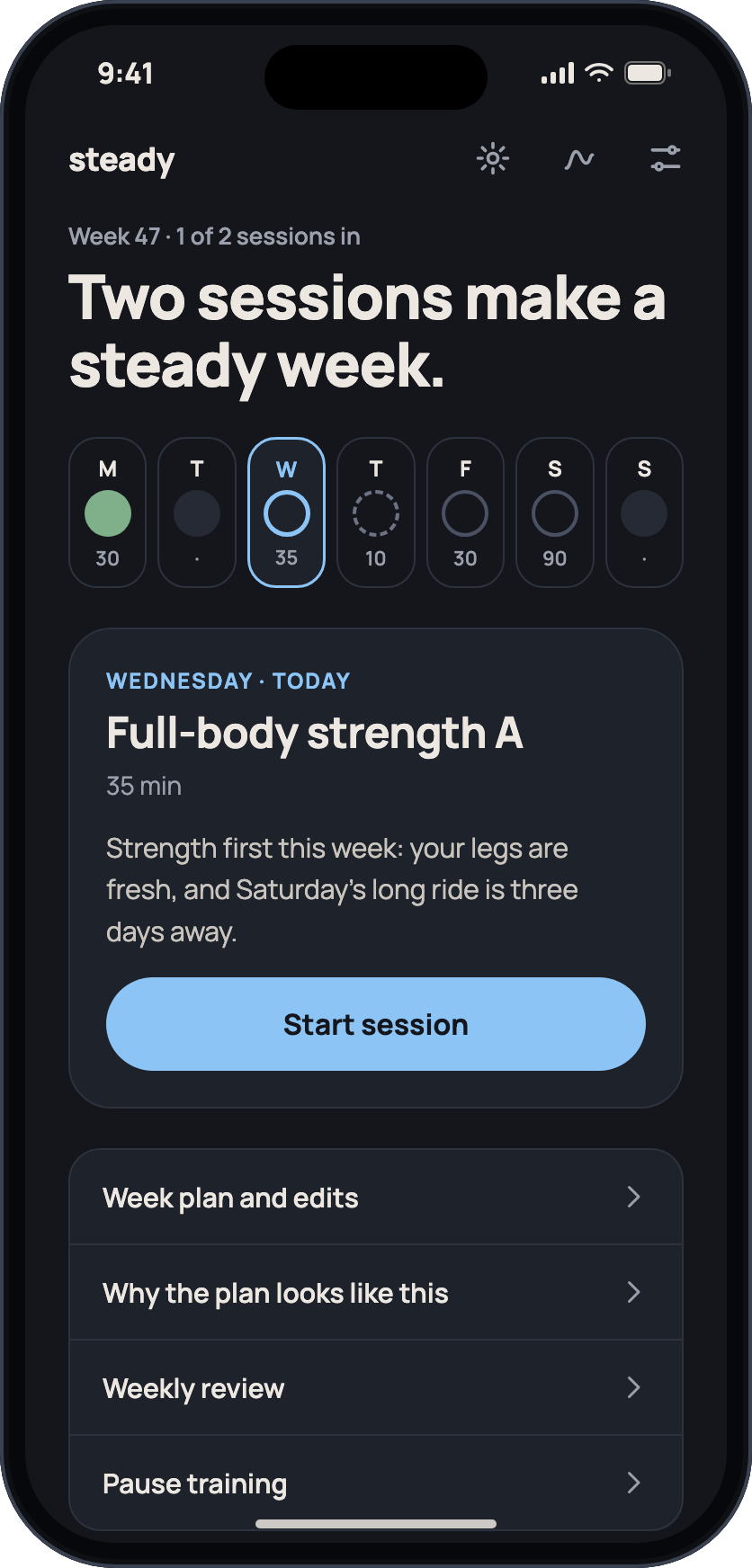
Today screen: “Two sessions make a steady week.” A row of seven days shows Monday done, Wednesday selected, and a card for today’s 35-minute full-body strength session with its reason and a Start session button.
08 · Today

One card for the day, with a reason

The headline sets the bar: two sessions make a steady week. Every session says why it is where it is, so an automatic plan reads as considered rather than arbitrary. Any day can be swapped for rest without a reason.

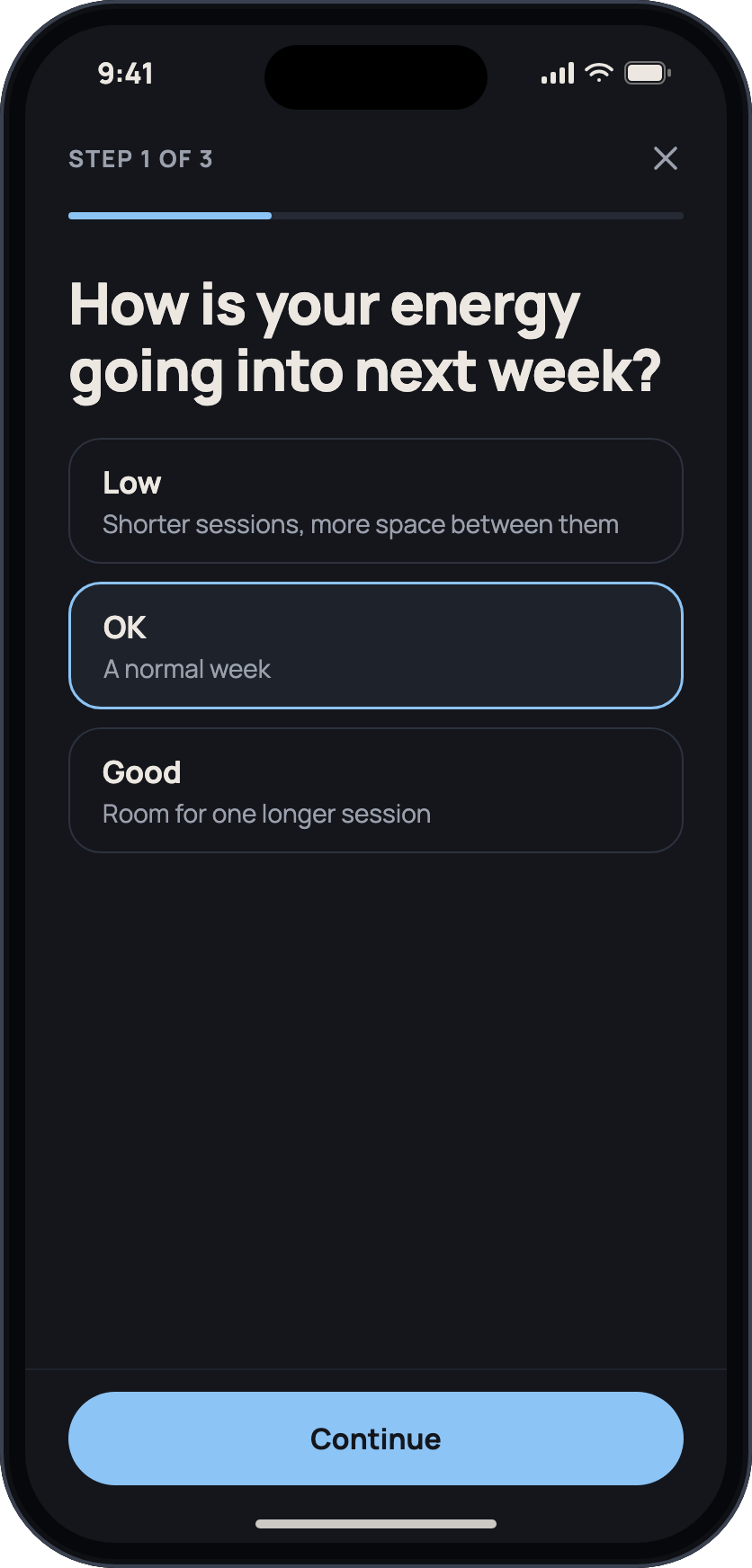
Weekly check-in, step 1 of 3: “How is your energy going into next week?” with three choices, Low, OK (selected) and Good, and a Continue button.
12 · Weekly check-in

Three questions, about 30 seconds

Energy, availability (pre-filled from the calendar) and known disruptions. Low energy changes intensity before frequency, so a tired week keeps its shape. Whether people will really do this weekly is hypothesis H3.

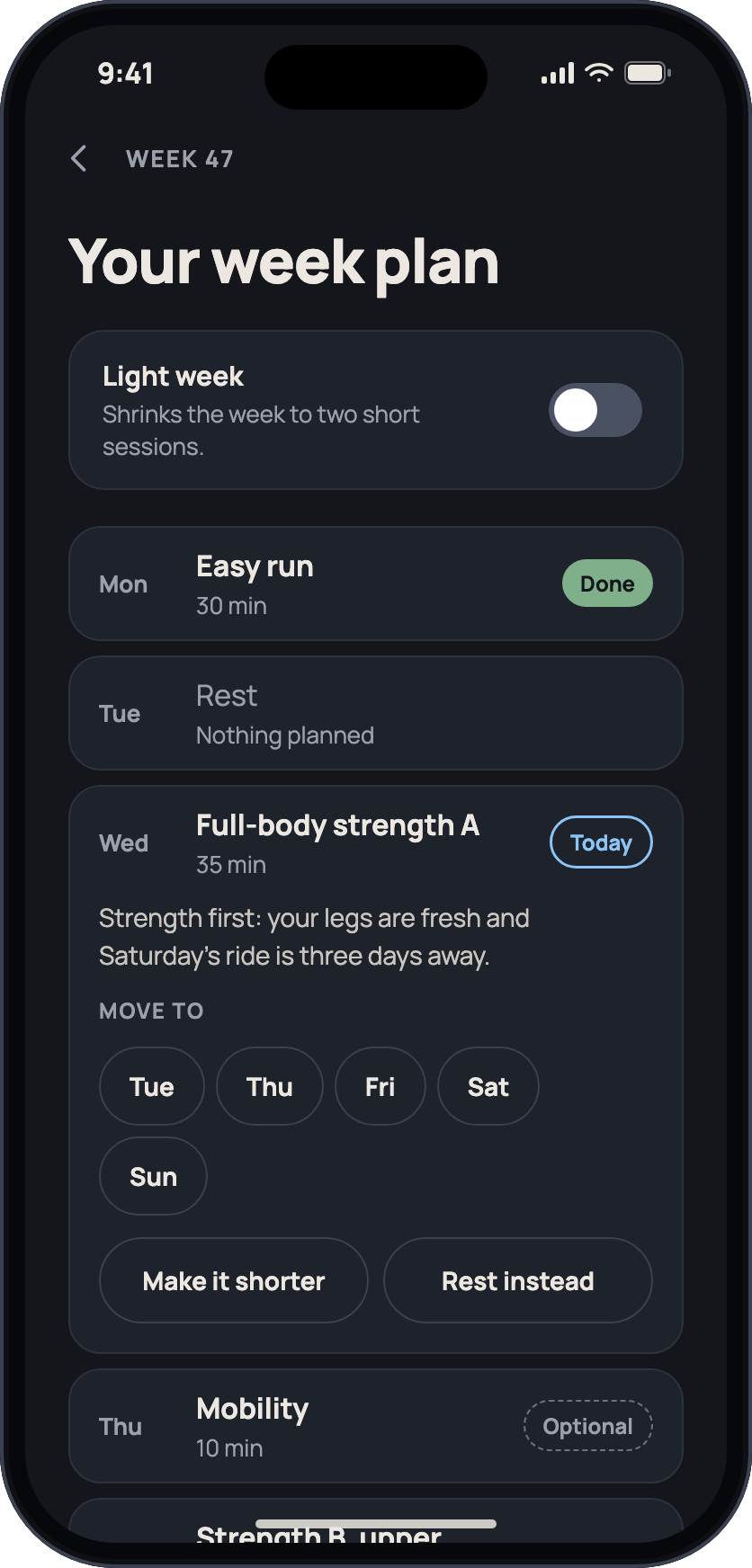
Week plan for week 47 with a Light week switch. Monday’s easy run is done, Tuesday is rest, and today’s strength session is open with Move to day chips and Make it shorter and Rest instead buttons. Thursday’s mobility is optional.
09 · Week plan

Plans bend in two taps

Move, shorten or rest, none of which asks why. One switch collapses the whole week to its minimum. The plan regenerates around every change and never lands on a calendar conflict.

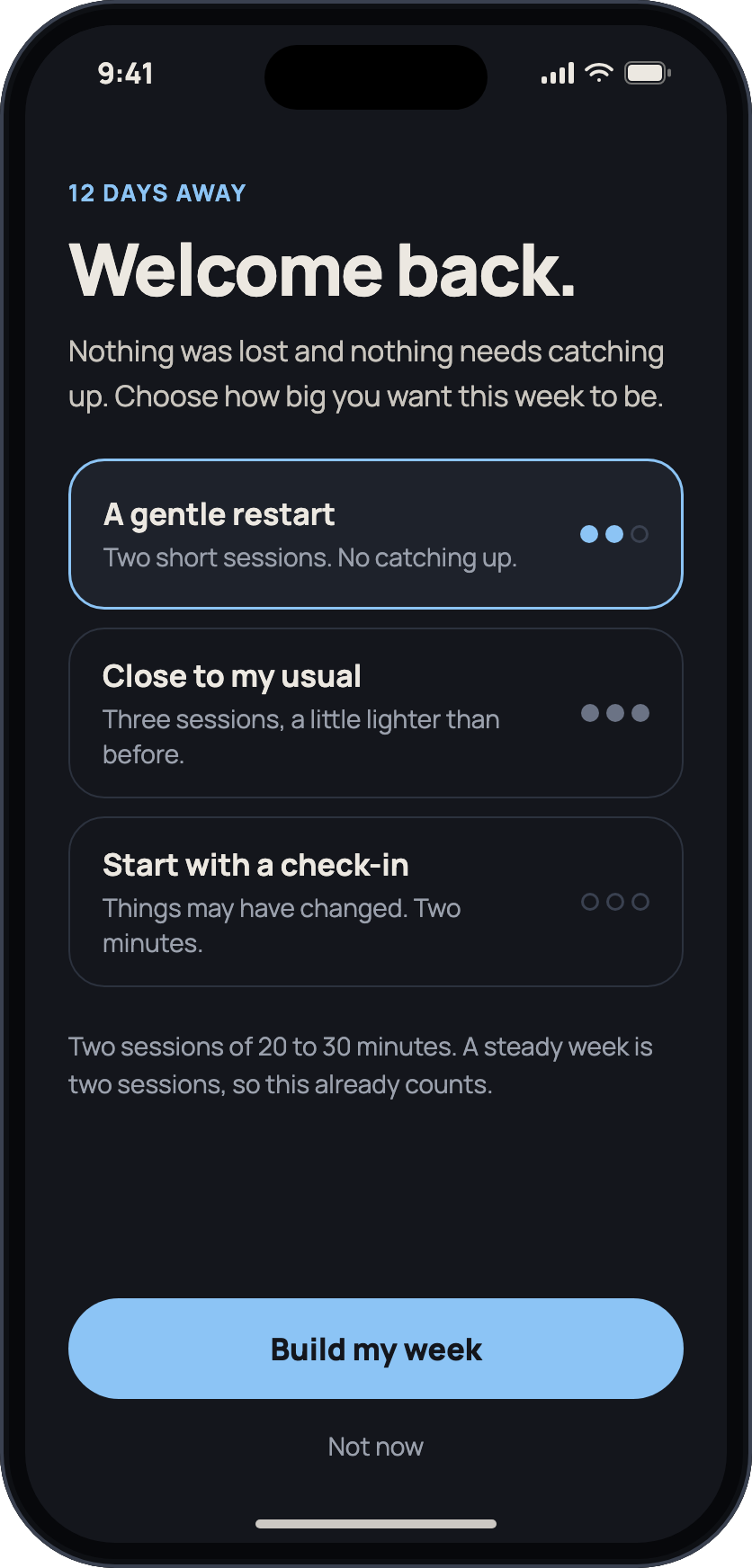
Welcome back after 12 days away: “Nothing was lost and nothing needs catching up.” Three choices: a gentle restart (selected), close to my usual, or start with a check-in, and a Build my week button.
14 · Welcome back

The moment after a miss decides retention

So it gets the best design effort, not a reminder. No loss message, no red state: a welcome and a choice of how big the week should be, with a gentle restart as the default. Whether this brings people back more often than a reminder is H1, the first thing to test.

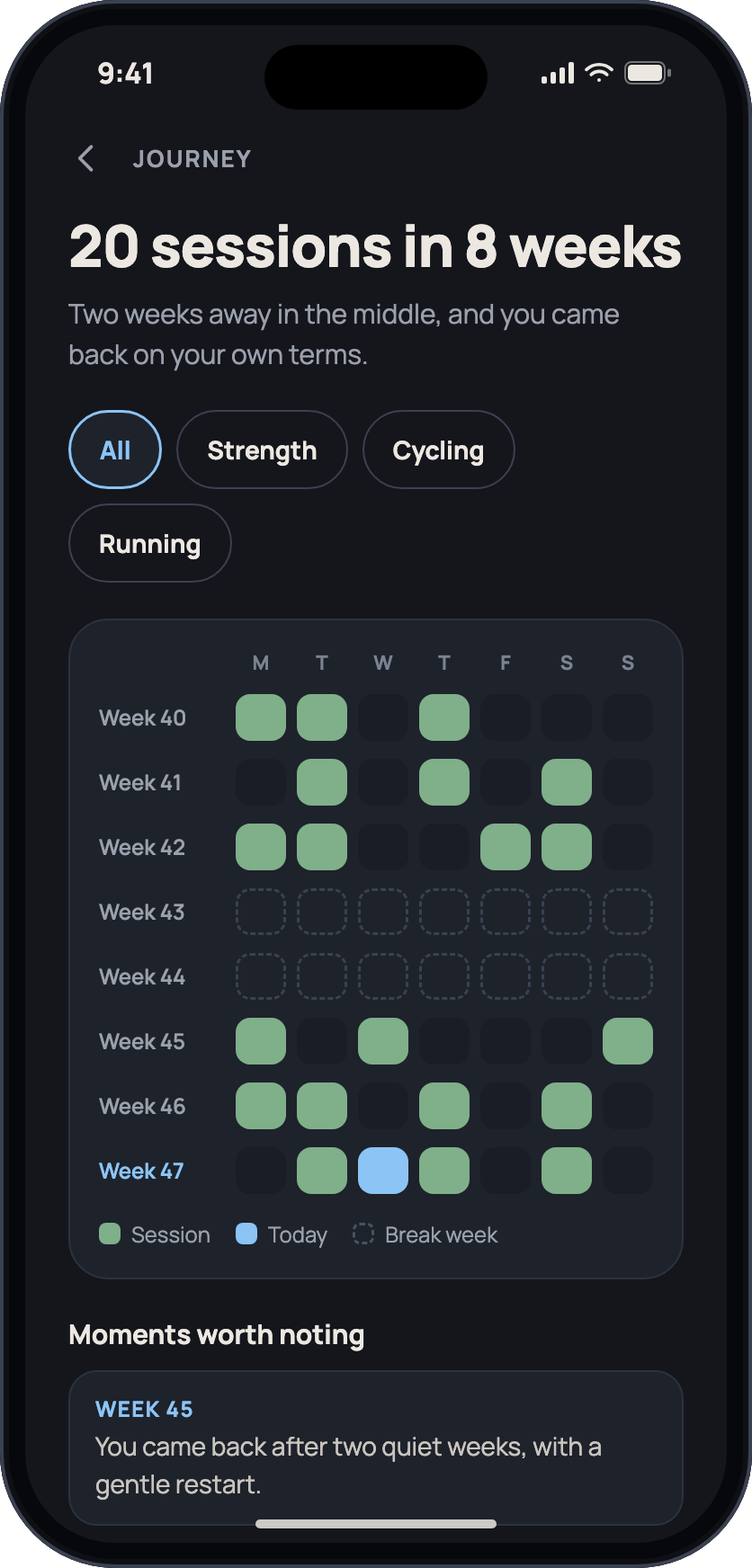
Journey: “20 sessions in 8 weeks. Two weeks away in the middle, and you came back on your own terms.” A grid of weeks 40 to 47 shows sessions as green squares and two break weeks as dashed outlines, with filters for all, strength, cycling and running.
17 · Journey

Compared only with your past self

The history shows showing up, not performance. Break weeks are quiet dashed outlines, and the notes worth keeping are about patterns, like coming back after two quiet weeks.

Every screen

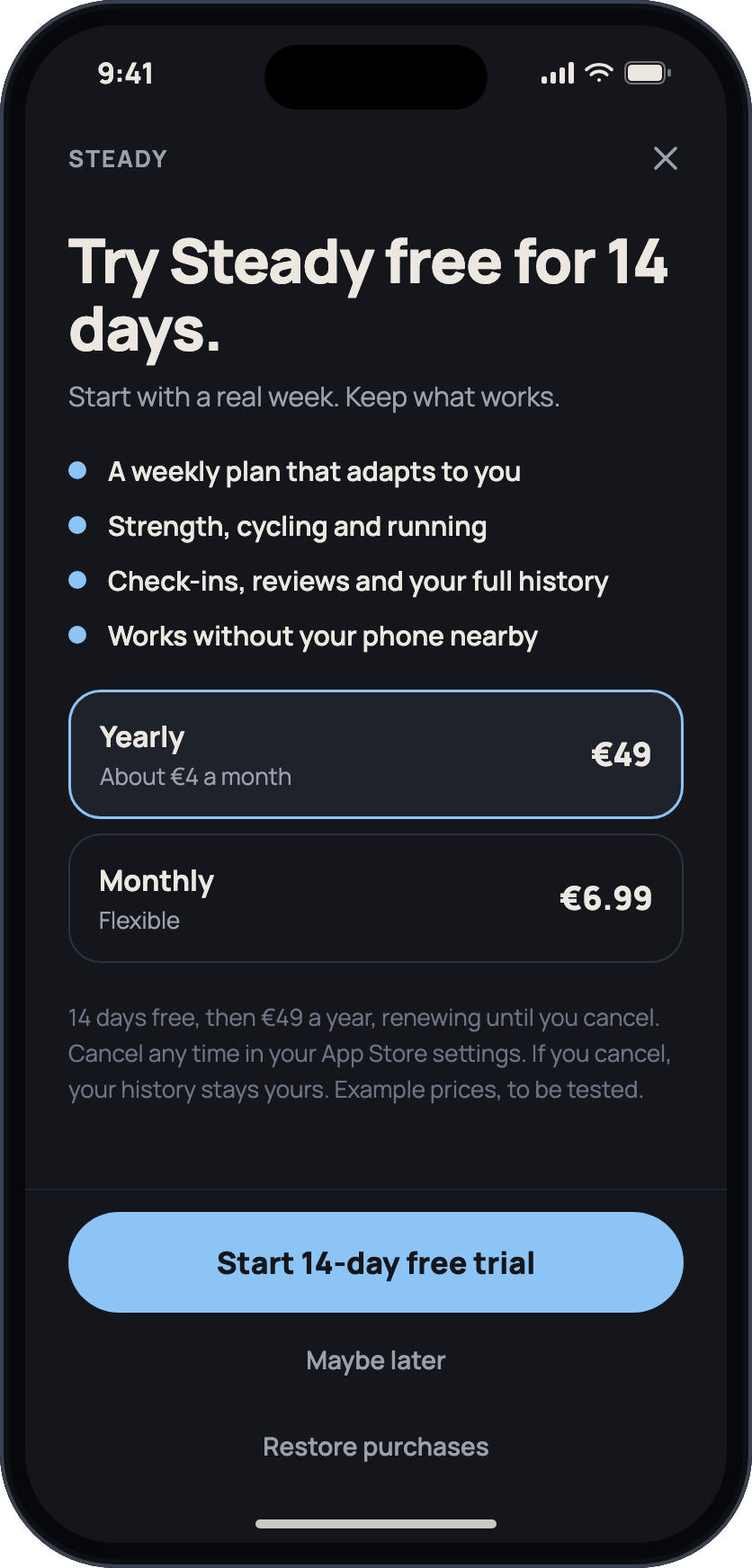
Built as a clickable prototype in the Dusk direction, one of three explored. Prices on the paywall are placeholders to test.

1 · Onboarding

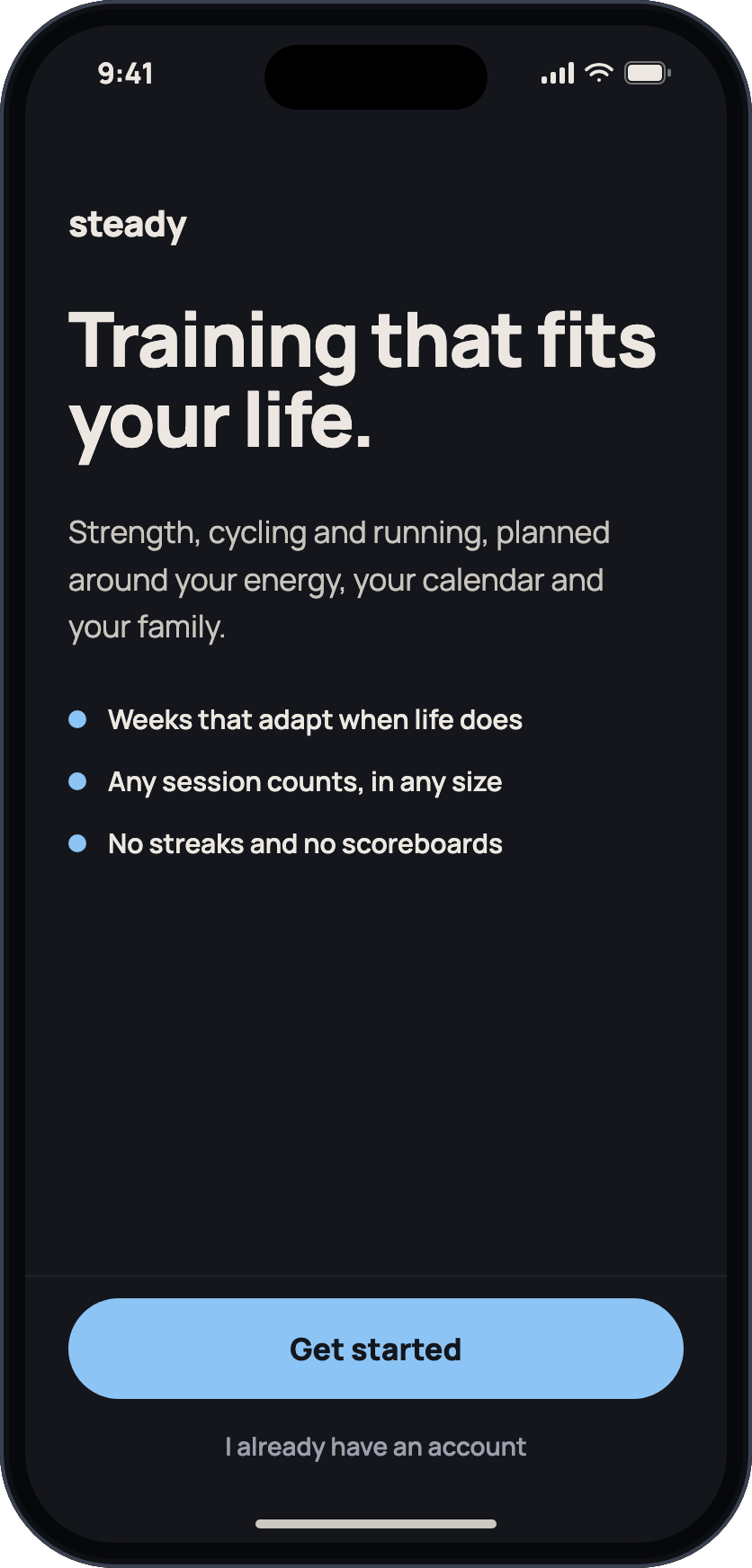
  • Welcome: “Training that fits your life.” Strength, cycling and running, planned around energy, calendar and family.
    01 Welcome
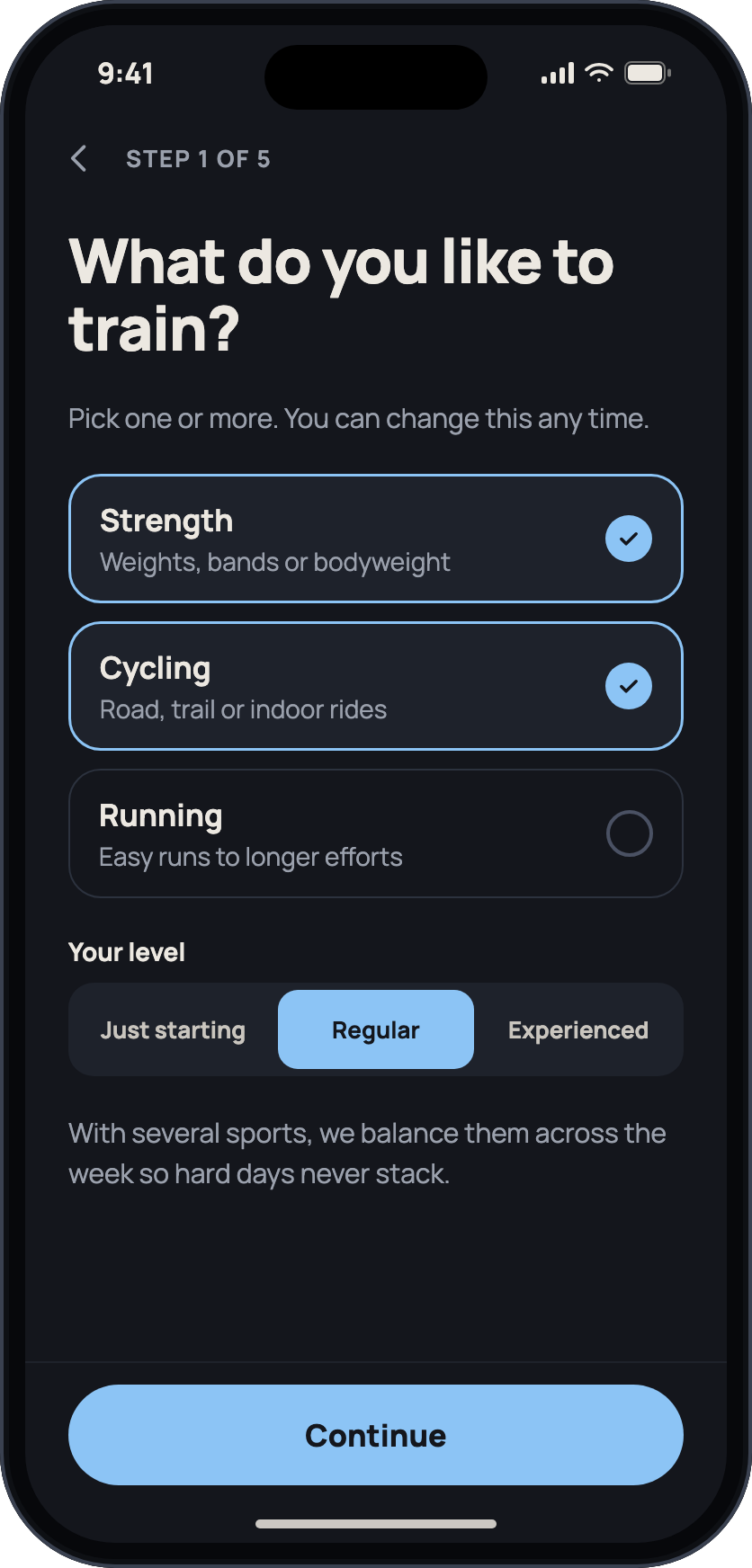
  • Pick sports: “What do you like to train?” Choose one or more of strength, cycling and running.
    02 Sports
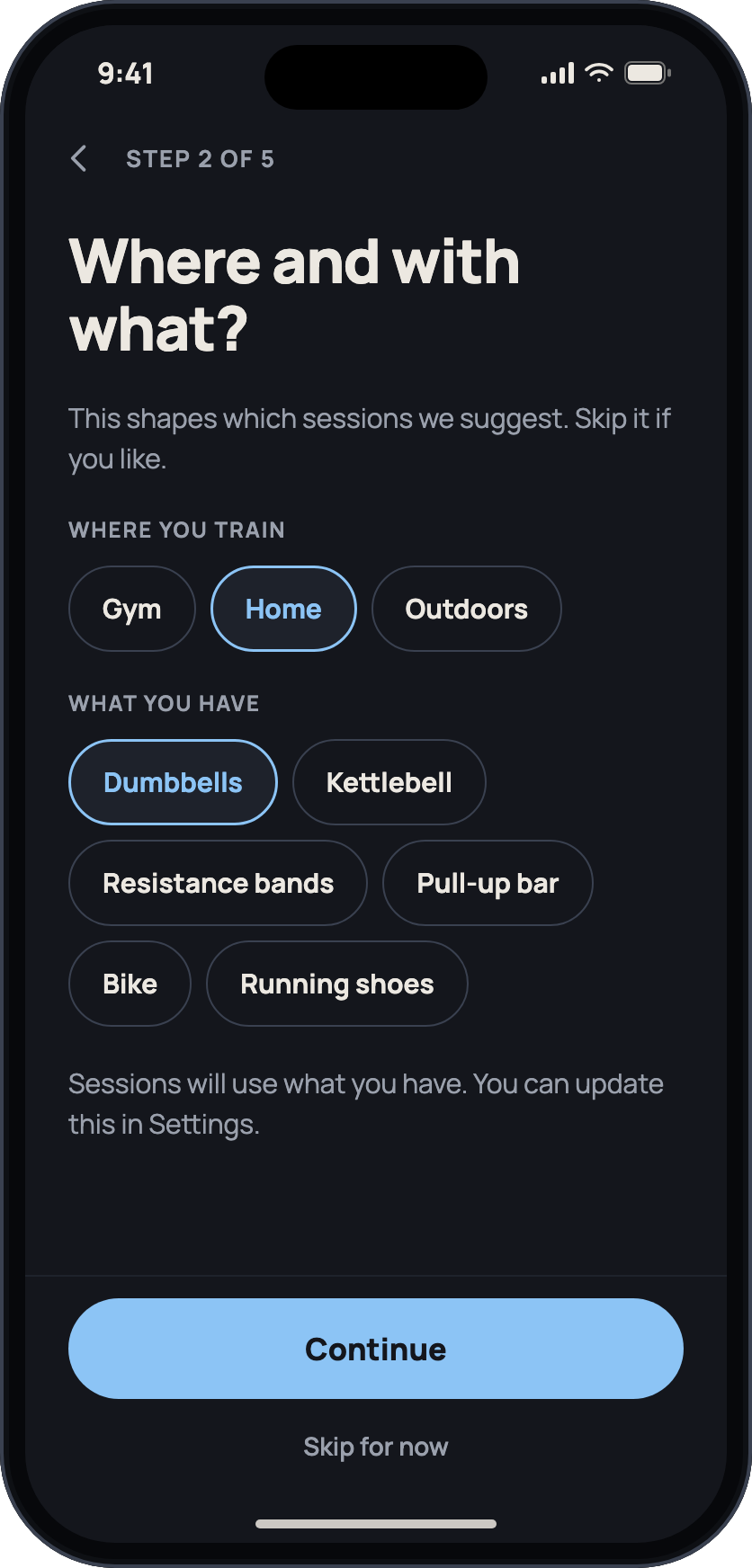
  • Equipment and places: “Where and with what?” Options shape which sessions are suggested; the step can be skipped.
    03 Equipment
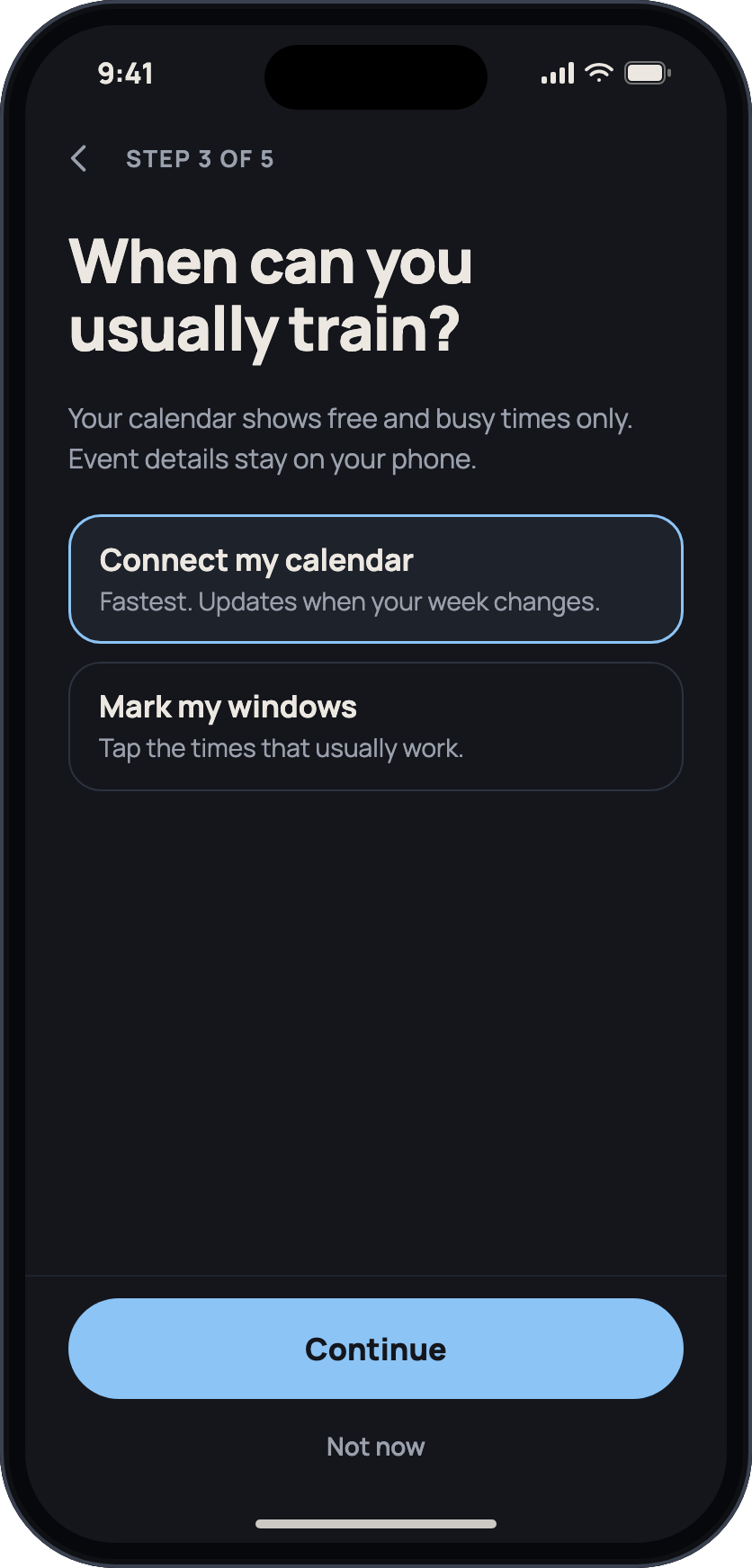
  • Typical week: “When can you usually train?” The calendar shares free and busy times only; event details stay on the phone.
    04 Typical week
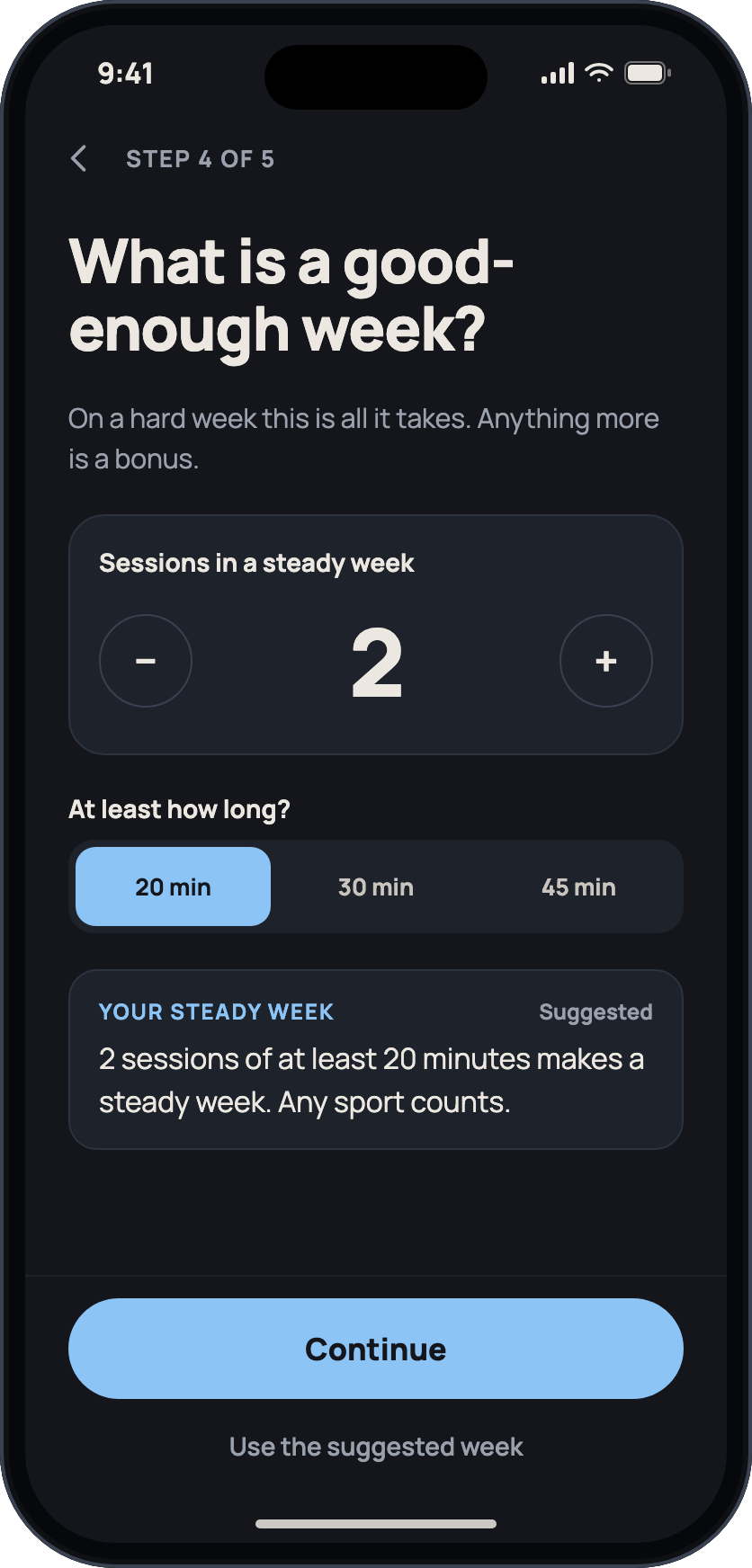
  • Minimum week: “What is a good-enough week?” On a hard week this is all it takes.
    05 Minimum week
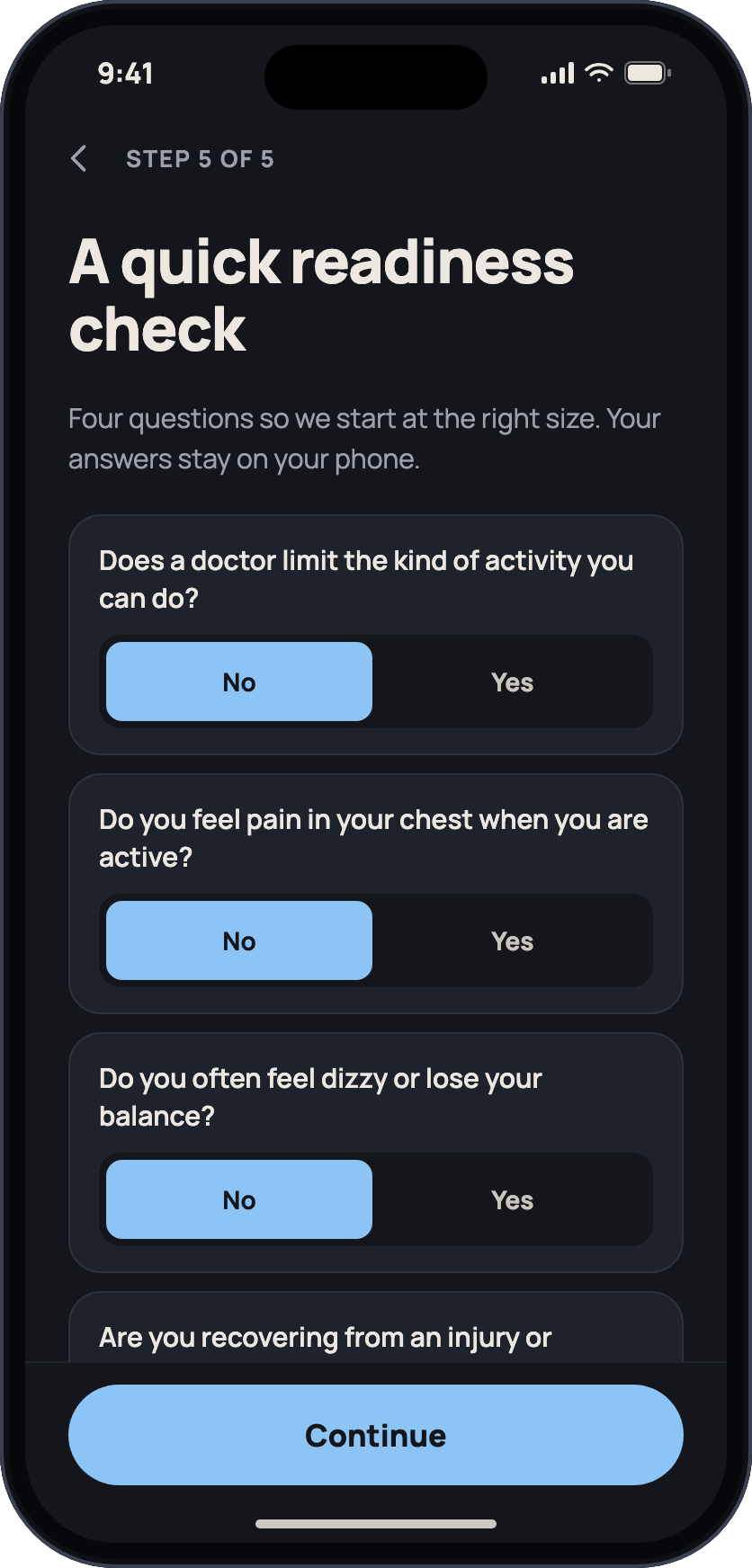
  • Safety: “A quick readiness check.” Four questions to start at the right size, with answers kept on the phone.
    06 Safety
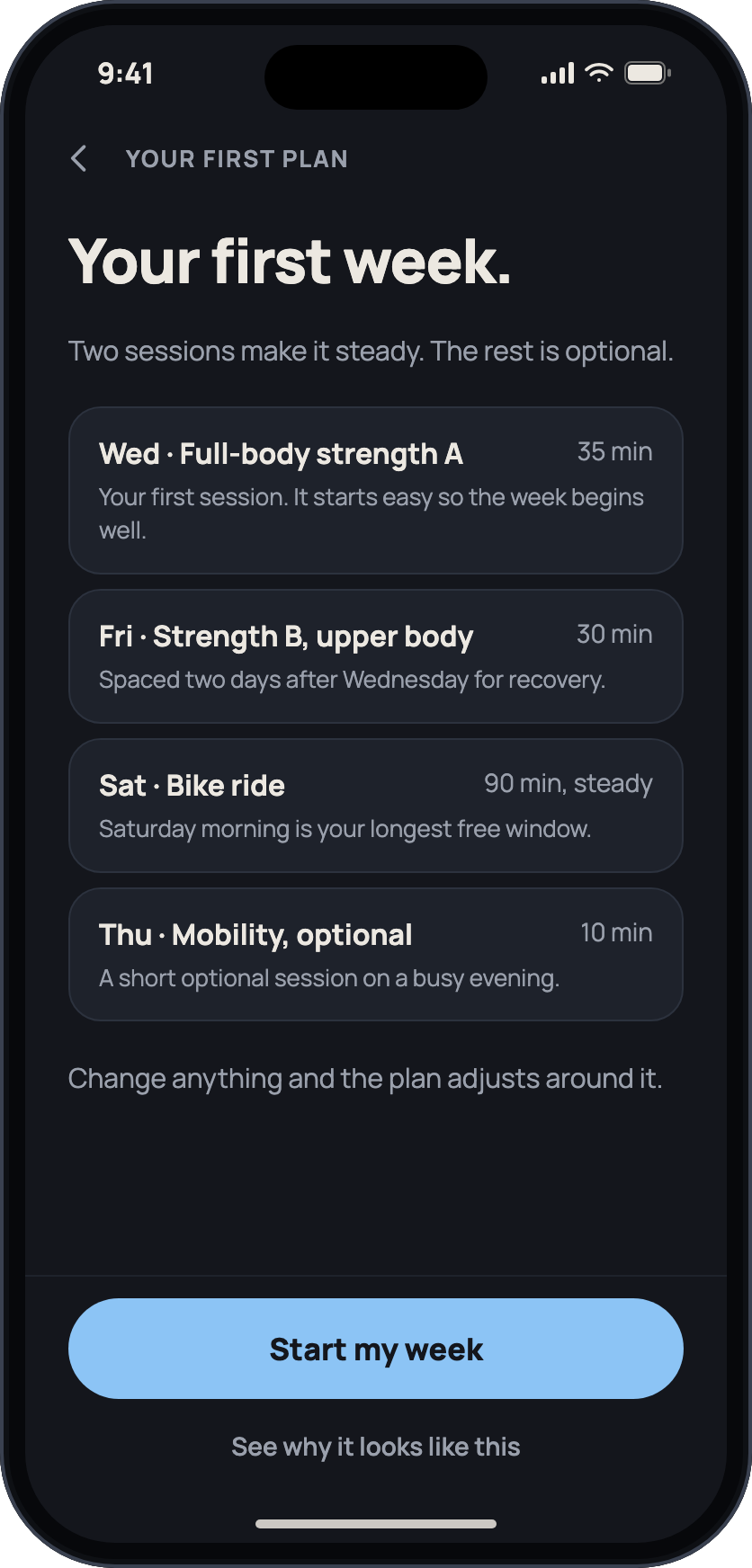
  • First plan: “Your first week.” Two sessions make it steady; the rest is optional. Each session shows its reason.
    07 First plan

2 · Weekly loop

  • Today: the day’s session card with its reason, a seven-day strip and links to the week plan, review and pause.
    08 Today
  • Week plan: seven days with a Light week switch, and move, shorten or rest actions on each session.
    09 Week plan
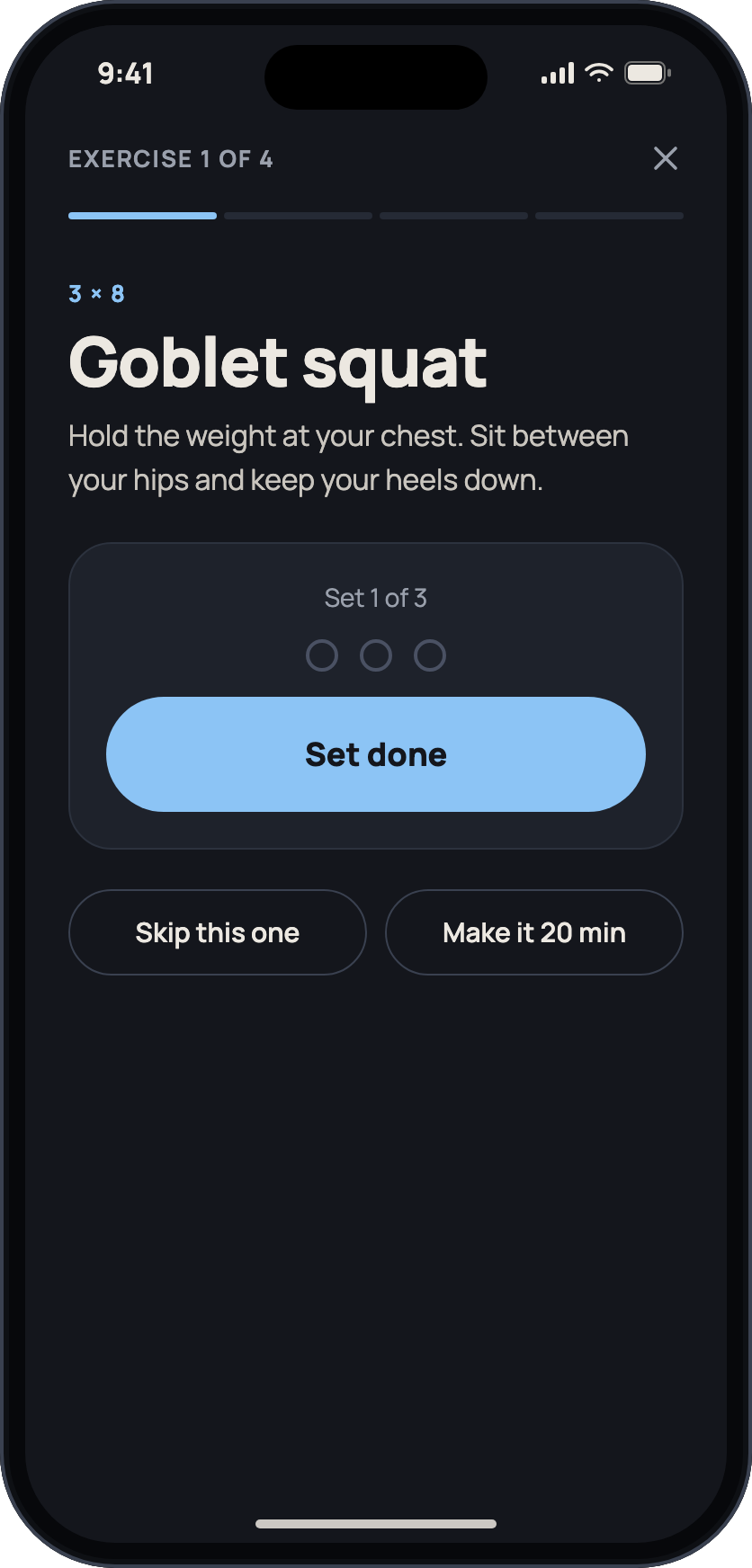
  • Strength session: guided exercise list with set logging.
    10 Strength
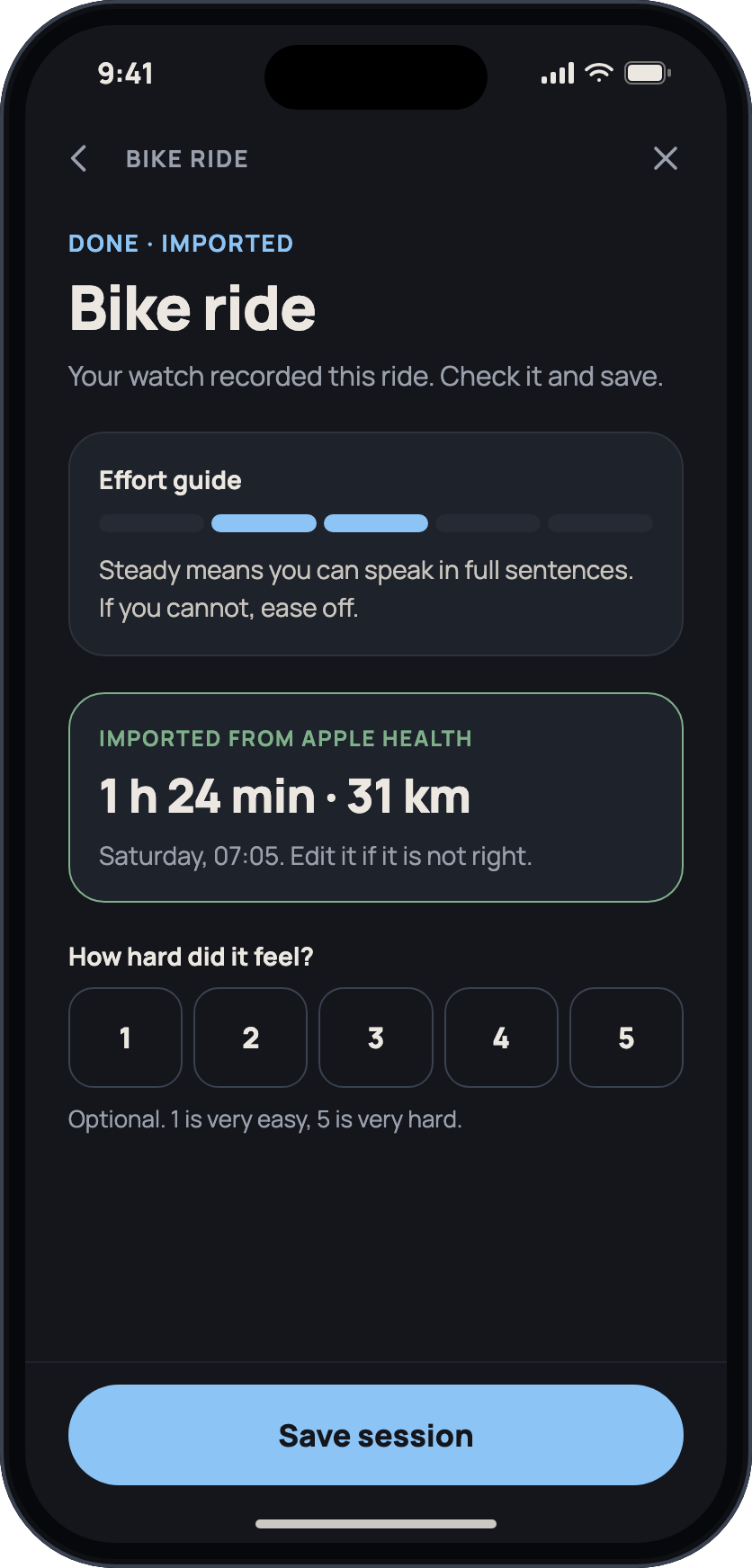
  • Bike ride, imported from Apple Health: 1 h 24 min and 31 km, an effort guide, and an optional how-hard-did-it-feel rating.
    11 Run or ride
  • Weekly check-in, step 1 of 3: energy going into next week, low, OK or good.
    12 Check-in
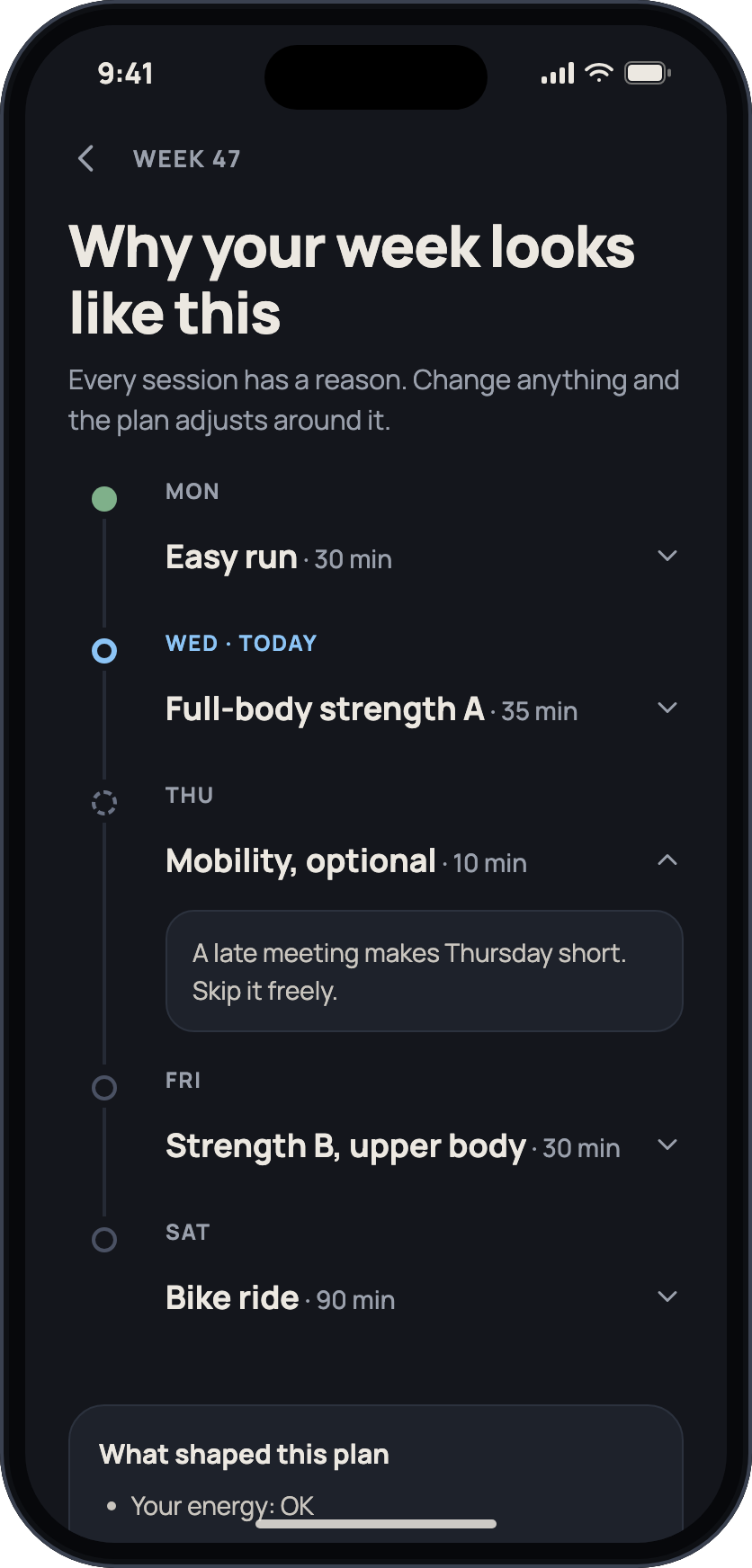
  • Your week: “Why your week looks like this.” Every session has a reason, and the plan adjusts around any change.
    13 Your week

3 · Recovery and account

  • Welcome back after 12 days away, with a gentle restart, close to usual, or a check-in.
    14 Welcome back
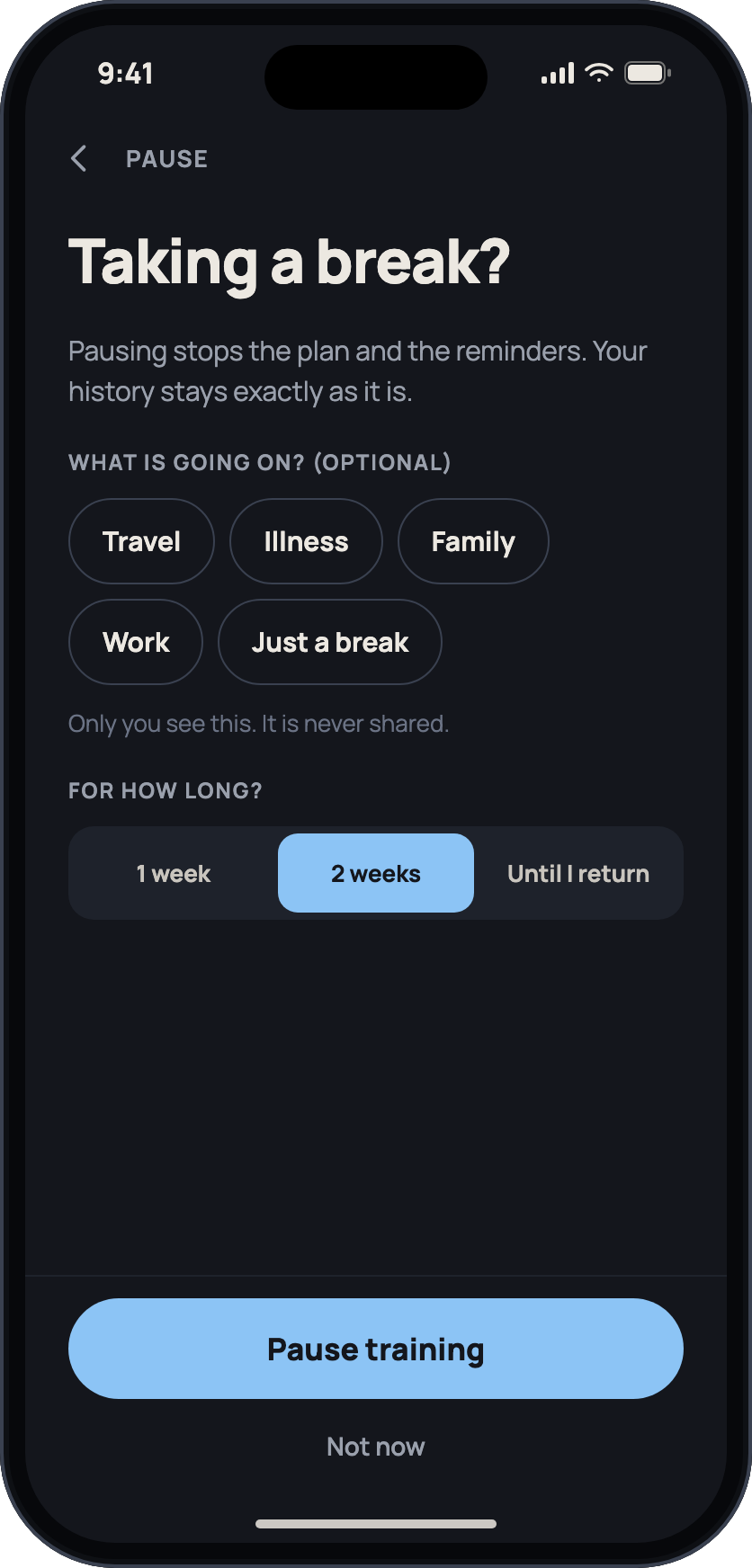
  • Pause: “Taking a break?” Pausing stops the plan and reminders, and the history stays as it is.
    15 Pause
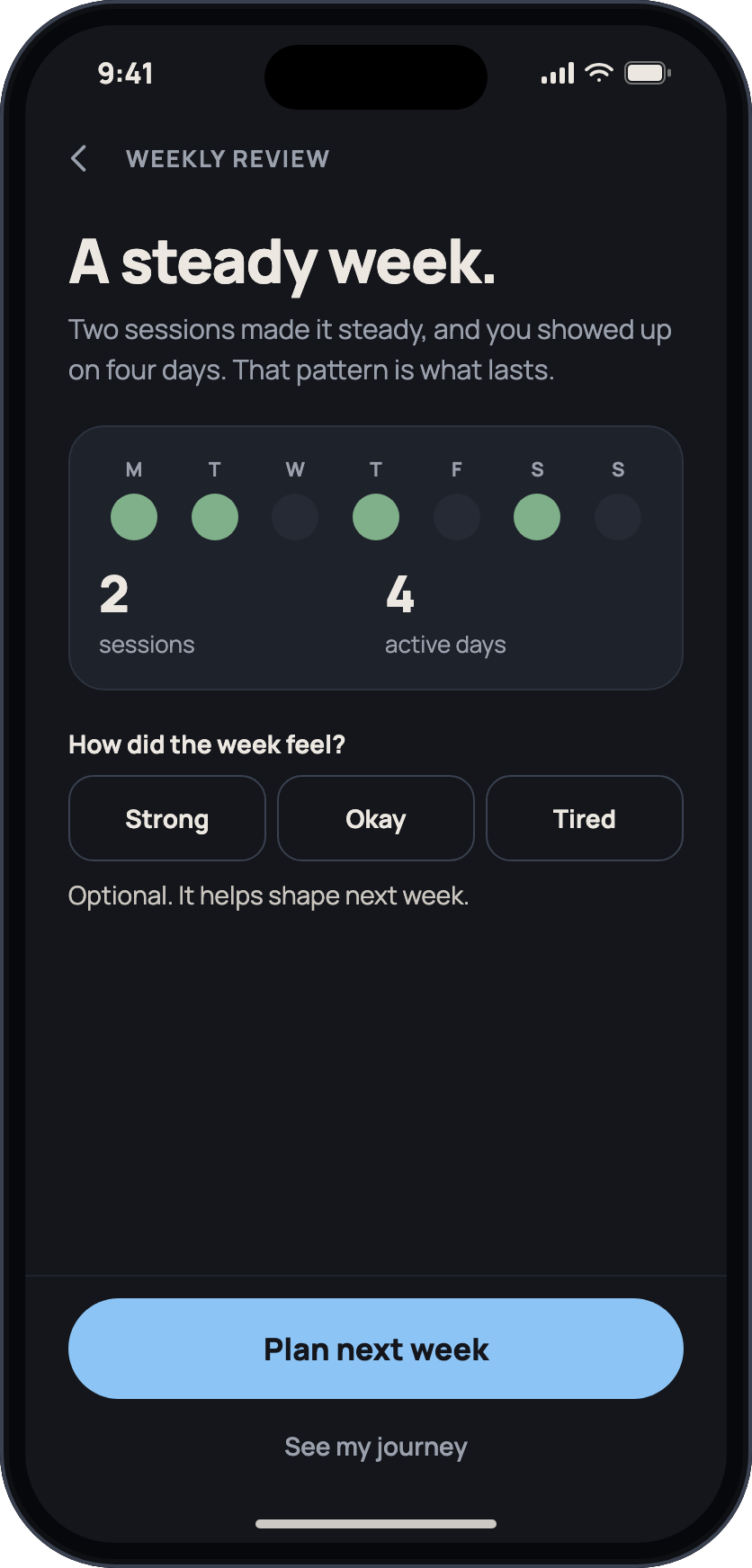
  • Weekly review: “A steady week.” Two sessions and four active days, with an optional how-did-the-week-feel question and a Plan next week button.
    16 Weekly review
  • Journey: 20 sessions in 8 weeks, with break weeks shown as dashed outlines.
    17 Journey
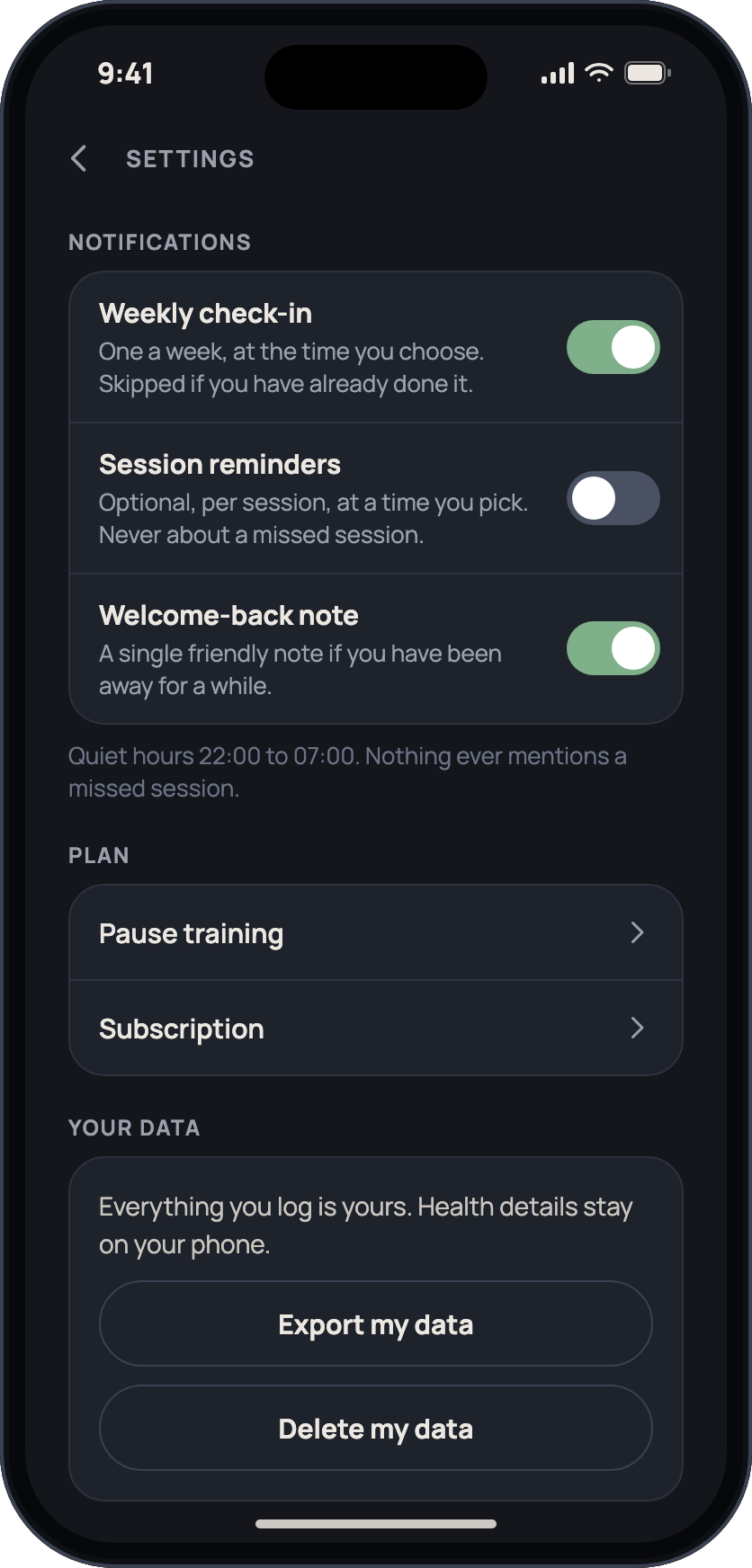
  • Settings: notification controls, privacy, data export and deletion, and subscription.
    18 Settings
  • Paywall: “Try Steady free for 14 days.” Yearly €49 or monthly €6.99, marked as example prices to be tested, with renewal and cancellation terms shown before purchase.
    19 Paywall

Decisions and what they cost

  • Weeks, not days

    A week that met a minimum is a more honest and forgiving unit, and it matches WHO’s weekly guidance.

    Cost: less of the daily pull that streaks create. If users ask, an opt-in daily view can be added (E2).
  • Absence is neutral

    A missed week is a quiet gap. Paused weeks don’t count at all.

    Cost: no loss aversion to lean on. H1 tests whether a welcome beats a reminder.
  • Quiet notifications

    Three types, user-controlled, none about a miss.

    Cost: fewer re-engagement touches. The opt-out rate is a guardrail, not an afterthought.
  • A rules-based planner

    Explainable, testable on fixtures and reviewable by a coach.

    Cost: less personalisation than a learned model. That can come once beta data exists.
  • Paywall after the first session

    People should feel a plan that fits their week, and ideally a recovery, before they are asked to pay. More than half of trial cancellations happen on day one.

    Cost: some users leave before seeing a price. Timing is experiment E5; trial length is E4.

Next: find out if it is true

Eight hypotheses hold the product up. The riskiest three are tested first, before any build is committed.

  • H1A welcome with a smaller plan brings people back after a missed week more often than a reminder.
  • H2A weekly consistency goal motivates this segment more than a daily streak.
  • H4One plan across three sports is worth paying for over single-sport apps.
  1. Weeks 1–2 · Diary and app auditTwo weeks with the closest competitors, and a heuristic review of five apps.
  2. Weeks 1–3 · Interviews12–15 adults from the segment, including four who abandoned a fitness app.
  3. Weeks 2–4 · Diary studyPlanned versus done, what disrupted it, how it felt.
  4. Weeks 4–5 · SurveyFeature priority and price questions, plus a fake-door paywall.
  5. Weeks 5–8 · Prototype testsTwo rounds on the weekly loop and missed-week recovery.
  6. After MVP · 12-week closed beta150–300 users, so week-12 retention is measured on real use.
Week-12 retention40%of activated users, 50% stretch
Weekly active days2.5+days with a session of any size
Subscription churn≤ 8%monthly from month 4; annual renewal 40%+

Proposed targets with no baseline yet; the beta sets the real numbers. Guardrails come first: the plan should feel manageable (4 of 5 or higher), notification opt-outs should fall, and reported guilt should stay low. Daily active users, time in app and streak length are deliberately not optimised.

Next case Pulse